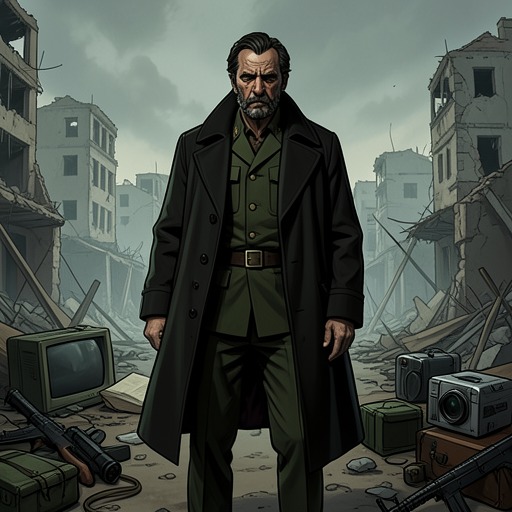
Euro-American conflict
Last and First MenThe Euro-American conflict is the catastrophe that destroys Europe and transforms the United States from a powerful influence into the agent of a continent-wide massacre. The war grows out of financial domination and political resentment, but its decisive turns come through an uncontrolled sequence of retaliations and the annihilation of an American air fleet. The victory that follows does not secure peace or vindicate the victors: it leaves Europe’s intellectual centers extinguished and reshapes American society through collective guilt.
Causes and Escalation
The conflict emerges from a long imbalance of power. American finance had become an intrusive presence in European life, and Europeans increasingly resented the influence of American businesspeople. Germany remained comparatively independent because it was still a major economic power, but friction with Americans was widespread there as well. Europe’s objection was not simply to foreign wealth: financial dependence had become a daily constraint, while the United States presented its own economic and cultural reach as a means of shaping the planet.
Neither side initially wanted war. Both understood that a general conflict could end prosperity and might prove existential for Europe, whose people knew that destructive power had recently increased. Yet restraint failed when a murder in southern Italy set off a chain of public and political reactions. Remarks in the European press provoked offensive American press retaliation; an Italian was lynched in the American Middle West; and American citizens were massacred in Rome. The United States then dispatched an air fleet to occupy Italy. European aircraft intercepted it, producing a temporary check to the American advance. Rather than resolving the crisis, that setback spurred the American side to prepare a crushing response. War was under way before either side formally declared it.
The Weapon and the Turning Point
While the United States mobilized its armament, an international society of scientists was meeting in England. A young Chinese physicist, who had been investigating the use of subatomic energy through the annihilation of matter, presented his work to a select committee at Hartland Point. His instrument offered a power of destruction the committee judged too dangerous to release. The forty representatives voted unanimously to destroy it, a decision that made its inventor feel that his labor had brought him rejection rather than gratitude.
The crisis reached the meeting when the physicist saw an approaching American air fleet. The English representative urged him to use the instrument, and the room called for the planes to be stopped. The American representative acknowledged that his own son and friends might be among the airmen, but said the pilots had entered a violent, vengeful state and asked that they be halted. With the President’s assent, the Chinese scientist aimed at the aircraft one by one; each became a brilliant point and disappeared. The French representative alone had protested against the decision.
The fleet’s destruction changed the meaning of the intervention. The American commander had been instructed merely to demonstrate over England while peace was negotiated; American business interests had opposed unnecessary violence because destroying Europe would destabilize American finance. But the unprecedented loss of the victorious fleet overwhelmed the peace party and roused the United States to hatred. What seemed to have checked the American advance instead helped doom Europe.
Afterward, the instrument and the manuscript explaining it were burned in a nearby field. The physicist insisted on shaking hands with those present, then declared that as long as his secret remained alive in him, he himself was a danger. He died by his own hand. The scene closes not with the triumph of a weapon but with its deliberate destruction and the death of the person who knew how to reproduce it.
Europe’s Destruction
Rumors of the disaster spread by voice and radio: people spoke of an island mysteriously exploded, the American fleet mysteriously annihilated, and a conference of scientists gathered near the events. The European Government sought the unknown savior, both to thank him and to obtain the destructive process. The scientific society’s President described the conference and its unanimous vote, but he and his colleagues were arrested. Authorities subjected them first to moral pressure and then to physical coercion, convinced that the scientists knew the secret and were withholding it.
One English scientist escaped disclosure through deception. He claimed that he would try to remember the intricate process and, under supervision, conducted experiments using his own knowledge of physics. He knew that he was pursuing a false trail. His initial aim was self-preservation, but he turned the deception into a sustained effort to keep the discovery beyond reach by lending an eminent physicist’s authority to a barren line of research. In the account’s grim irony, this betrayal helped prevent an already undisciplined humanity from destroying its own planet.
The Americans answered the fleet’s destruction with a poison-gas attack across Europe. The gas lost its potency within three days, allowing American sanitary forces to enter the cities within a week, but that limited duration did not limit the scale of the killing. The gas rose from ground level and overwhelmed people seeking refuge at greater heights. Europe’s cities became places of mass death, and the invasion forces encountered the population’s remains throughout the urban landscape.
Europe died as a center of intellectual life. Its major centers were blotted out, and only upland and mountainous agricultural districts escaped the attack. The European spirit did not vanish entirely, but survived thereafter in fragmented form among Americans, Chinese, Indians, and other peoples. The British Empire also disintegrated. Canada sided with the United States; South Africa and India declared neutrality; and Australia soon became neutral because of divided loyalties. New Zealanders resisted from the mountains for a year, remaining loyal to England as a symbol of European identity despite their Americanization. When continued resistance became impossible, many chose death rather than submission.
Victory, Guilt, and Historical Consequences
The war’s deepest lasting agony falls on the victors. The narrative depicts Americans not as inherently brutal but as a people who had thought of themselves as kindly purveyors of pleasure and who were unable, after the attack, to conceal from themselves that they had committed mass murder. Their guilt did not produce a steady return to restraint. Instead, it warped the national mind: vainglory and intolerance intensified, as did fear of criticism, blame, hatred, self-righteousness, hostility to critical intelligence, and superstition. The United States emerges victorious in military terms, but its victory becomes a source of political and psychological damage.
The conflict also belongs to a longer pattern in which economic systems connect distant powers while turning their dependencies into strategic vulnerabilities. Earlier disputes over Russia’s economic relationship with the United States had already made finance a source of European resentment and helped consolidate European opposition. In the war itself, the dependence of American prosperity on European economic stability briefly restrained the use of force; the destruction of the fleet then overwhelmed that calculation. Commercial interdependence neither prevented conflict nor survived it intact.
After the war came a century of smaller national conflicts, followed by a century of strained peace in which the United States and China grew increasingly antagonistic. The conflict therefore marks both Europe’s end as a coherent center of civilization and the beginning of a changed global balance. Its central reversal is stark: an act meant to halt an approaching fleet triggers the decision that destroys Europe, while the winning power inherits a guilt that further distorts its political character.